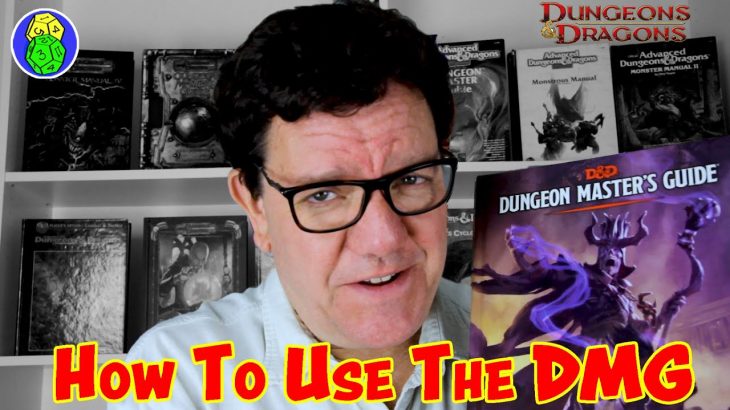
You sometimes hear people say that in order to run a D&D campaign you really only need the Player’s Handbook and the Monster Manual, which relates to the characterization of the material in the Dungeon Master’s Guide as fluff versus the crunch of those two books. And even though I disagree with that view, I will admit that while it’s important to read the Player’s Handbook from cover to cover to play D&D and eventually you’ll read every monster in the Monster Manual, you can skim through quite a bit of the DMG without missing that much. But I think every GM should invest in this book, if not just for the various magic items that are listed, but also for the wealth of ideas it can inspire if you want to truly homebrew your own campaign and world.
One aspect of the DMG is that it provides lists of ideas with very little explanation, and one such list inspired this video. A list of exotic dungeon locations listed a classic D&D cliché; the old “cave slash dungeon behind the waterfall” trope. That is, whenever you are running in a wilderness or even sometimes underground and you encounter a waterfall, you know there is something, usually a cave or dungeon entrance, behind that water.
But like all cliches it’s also a reflection of truisms; in the case of waterfalls both as a real geological feature and its relation to myth, religion and fantasy literature. So it’s natural to associate them in a fantasy game with a unique encounter or power, or gateway to another plane, or associate the surrounding area with elemental forces.
And here in lies the issue; most players are well aware of waterfalls’ association with these D&D encounters and they meta-game them; always looking behind the wall of water for whatever goodies the GM has inevitably place there. So as always you want to honor the roots of this D&D cliché but change things up so that it’s unique and interesting.
This auditory and visual component of a waterfall is going to be affected by the type of waterfall and the volume of water that flows over it. So the simplest definition of a waterfall is river or creek that flows over a change in elevation. The snow melt falls of Yosemite Valley are very sparse where as the Niagara River has a volume of over 75,000 gallons per second. So you want to make sure that the area around your waterfall supports its existence with a logical you’ve got elevation change.
So I’ll give a couple of examples here of various waterfall types and how you might integrate them into your campaign. A big part of getting away from the cliché is to think about the area above and below the falls, and then the surrounding terrain. You’ve got your classic block falls which includes Niagara Falls and the Huangguoshu Falls in China.
Now below the falls we think of deep pools that form from the relentless actions of the water. You could have bandits that gather there to collect booty that falls into this pool, perhaps the water action has allowed the pool to breach some underground river source that is otherwise inaccessible.
Or you could manipulate the “cave behind the water” cliché. Bandits spreads the story of a cave behind the waterfall. But there is no cave, no treasure and no safe passage. These thieves lure unsuspecting to go on a path behind the falls, knowing that they will be swept into the river and they know where the bodies and booty will accumulate.
I also talk about other types of falls such as the cataract fall, which usually have a gorge at the bottom, which provides excellent adventuring terrain. Another is the plunge fall, where the water flows away from the rock pretty much the whole way down. Angel Falls in Venezuela is a famous example of this, and it combines jungle terrain and climate with the geology of a mesa.
What your doing in all of these cases is taking a very brief prompt, “behind a waterfall” and fleshing it out by thinking about how this geological feature appears in the real world, then taking that terrain and applying it to the game mechanics of D&D and the traditions of fantasy fiction and story. None of this is given in the manual itself, but each of these prompts gives you a kernel to start that process of fleshing things out.
xxxxxxxxxxxxxxxxxxxxxxxxxxxxxxxxxxxxxxxxxxxxxxxxxxxxxxxxxxxxxxxxxx
Here are more products you can use to start playing D&D and create your own homebrewed campaign:
Player’s Handbook 5e, Amazon Affiliate Website Link:


