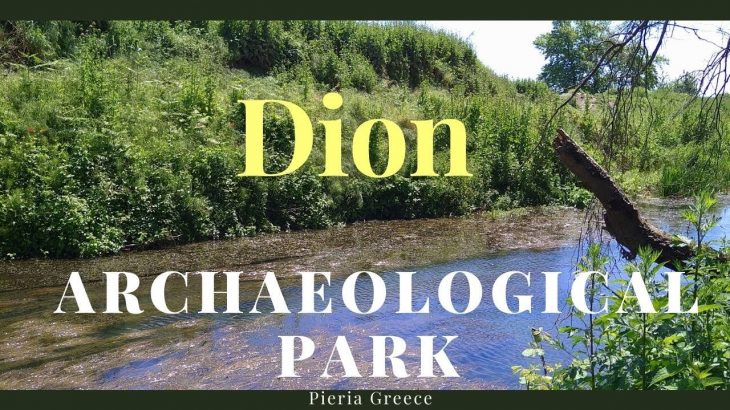
The Archaeological Park of Dion is the most important archaeological site at Mount Olympus in Greece, located in Dion (Greek: Δίον). In the area comprised by the Archaeological Park of Dion, sanctuaries were found from the Hellenistic and Roman periods. The park displays the importance of ancient Dion in the history of Pieria.
History
Thucydides mentions Dion as the first city reached by the Spartan general Brasidas, coming from Thessaly (Tempi) in Macedonia. Pausanias mentioned Dion as one of the places at Orpheus had lived.
In the Hellenistic period, Dion became the religious center of Macedonia. Zeus was venerated here, and Olympic games were held in honor of Zeus and the Muses. The village of Dion gained a certain importance within Greece through the sanctuary and over time developed into a city. Alexander the Great sacrificed to Zeus in Dion before he began his campaign against the Persians. Later, he had 25 bronze statues of the cavaliers fallen in the Battle of the Cranicos, erected in the Zeus Olympios Shrine. In the year 219 BC, the city was destroyed by the Aitolians. Philipp V had the city rebuilt immediately. The Romans took the city 169 BC. Gradually, Roman settlers came to Dion and brought their officialdom, their units of measurement and weight units with them. In the course of the changing owners, more sanctuaries were built. After the middle of the 3rd century AD, the decline started by the raids of neighboring tribes, earthquakes and floods. In the fourth century AD, Dion (Dium) experienced a last flourishing when it became the official seat of a bishop. The place is last mentioned as an administrative district of the Byzantine emperor Constantinos Porphyrogennetos in the 10th century.
Important Sites
Isis Sanctuary
The most recent of the sanctuaries in Dion is the sanctuary of Isis. It was erected in the second century AD on the site of a former fertility sanctuary. The plant has a considerable size and is traversed by a channel, which is to symbolize the river Nile. The main entrance is in the east, i.e. the side facing the sea. A minor entrance is found on the north side of the sanctuary. The temple and altar of Isis Lochia (Isis as the guardian of the child’s bed) are framed in the western part of the complex by two smaller temples of Isis Tyche and the Aphrodite Hypolympiada.
Hellinistic Theatre
The classical theater, in which the premiere of Bakchen of Euripides took place, was replaced in the 3rd century BC by the Hellenistic theater. A semi-circular mound of earth was laid on which brick-built seats were placed. A digging around the round orchestra ensures the drainage of the rainwater. Underground rooms and hallways allowed the appearance and disappearance of actors and objects. The stage was slightly higher than the orchestra.
Roman Theatre
The Roman theater was built in the 2nd century AD. It had 24 rows of seats arranged in a semicircle. Below the row of seats were 14 brick vaults. The orchestra had a diameter of about 21 meters. The building was built of bricks, field stones and mortar. The stage and the koilon (the auditorium, the seats) were separated; The stage was decorated with marble elements. Among the exhibits excavated there was a statue of Hermes.
The City Walls
Since Dion was one of the few ancient Greek cities that lay in a single plane without any elevation, the city wall was particularly important in defense against attackers. In the east, the Vaphyras’ marsh formed some protection, but there was neither a natural elevation nor an acropolis.
The city wall was built from the limestone of Mount Olympus between 306 and 304 BC, under the rule of the Macedonian king Kassander. It was 2625 meters long, three meters thick and seven to ten meters high.
The Thermal Baths
All the thermal baths have the same structure as they have a pool with cold water basins and other basins with differently tempered water. Also the type of heating, by a hypocaust-system lying under the floor, is the same for all mentioned thermal baths.
The great thermal baths were built in the 2nd century AD. A hall covered with a mosaic floor leads to the bathing cabins and the water basins. There were rooms where Asclepios was worshiped. The so-called “thermal baths of the main street” are located east of the main street, opposite the wall with the stone armors and shields.
Camera: SJCAM SJ7 Star and Sony Xperia 10 II
Music
Alexander Nakarada – Leaving for Valhalla
chZ – Bless My Soul
Frank Dorittke – Alone In The Dark
Leaving for Valhalla by Alexander Nakarada


